Left ventricular hypertrophy (LVH) is one of the most serious cardiac risks associated with androgen use — and one of the least discussed with precision. Most conversations stop at "steroids are bad for your heart." The more useful question is: which pathways actually drive the pathological remodeling, and what specifically blocks them?
Understanding this gets you from vague risk awareness to a mechanistically grounded prevention framework.
What Is Left Ventricular Hypertrophy?
The left ventricle is the heart's primary pumping chamber — it drives oxygenated blood into the aorta and out to the body. Under sustained pressure or volume overload, the LV adapts by growing larger and thicker. This isn't always pathological: athletes develop a form of LVH driven by increased cardiac output and volume loading that is generally considered benign or even beneficial — the so-called "athlete's heart."
Pathological LVH is different. It's driven by neurohormonal signaling — primarily through the RAAS and adrenergic systems — rather than functional demand. The cardiomyocytes don't just stretch and strengthen; they undergo fibrotic remodeling that stiffens the ventricle wall, impairs diastolic filling, and increases arrhythmia risk. Over time, pathological LVH is independently associated with:
- Increased risk of sudden cardiac death
- Heart failure (both systolic and diastolic)
- Atrial fibrillation
- Stroke
Androgens accelerate pathological remodeling through their effects on both the RAAS pathway and the sympathetic nervous system — two distinct but complementary mechanisms.
The RAAS Pathway: The Primary Driver
The renin-angiotensin-aldosterone system (RAAS) is the body's primary long-term blood pressure and fluid regulation mechanism. Under normal conditions it's essential. Under chronic androgen use, it can become a driver of cardiac damage.
How RAAS Drives LVH
The key molecule is Angiotensin II, produced when renin cleaves angiotensinogen → angiotensin I, which ACE then converts to angiotensin II. Angiotensin II acts on AT1 receptors and:
- Causes vasoconstriction, raising blood pressure and increasing LV afterload
- Directly stimulates cardiomyocyte hypertrophy independent of blood pressure effects
- Activates fibroblasts, driving collagen deposition and myocardial fibrosis
- Promotes aldosterone release, causing sodium and water retention (increasing preload)
Androgens amplify this pathway. They upregulate components of the RAAS, increase angiotensin II sensitivity, and promote the vasoconstriction and fluid retention that chronically stress the LV wall.
Critically, RAAS-pathway polymorphisms show a stronger association with LVH risk than the polymorphisms linked to skeletal muscle growth — meaning genetic susceptibility to androgen-driven cardiac remodeling is a distinct trait from susceptibility to the anabolic effects people actually want.
The Evidence for ARBs
An analysis spanning 80 clinical trials examined which drug classes most effectively reduce LV mass. The findings placed Angiotensin Receptor Blockers (ARBs), ACE inhibitors, and calcium channel blockers at the top — and this effect held even after controlling for treatment duration and the magnitude of blood pressure reduction. This means ARBs are doing something beyond just lowering blood pressure: they're directly interrupting the hypertrophic signaling.
| Drug Class | Mechanism | Effect on LV Mass |
|---|---|---|
| ARBs (e.g. Telmisartan) | Block AT1 receptor | ↓↓↓ (strongest evidence) |
| ACE Inhibitors | Reduce angiotensin II production | ↓↓↓ |
| Calcium Channel Blockers | Reduce afterload, some direct effects | ↓↓ |
| Beta Blockers (e.g. Propranolol) | Reduce adrenergic signaling | ↓ (smaller average effect) |
| Diuretics | Reduce preload | ↓ (variable) |
Telmisartan: The ARB of Interest
Telmisartan is an ARB with several properties that make it particularly suitable in this context.
It's a selective AT1-receptor antagonist — it blocks angiotensin II from binding to the receptor responsible for vasoconstriction, cardiomyocyte hypertrophy, and fibrosis, without affecting AT2 receptors (which have cardioprotective and antifibrotic effects). This selectivity matters: ACE inhibitors reduce angiotensin II production entirely, which is effective but also suppresses AT2-mediated beneficial signaling.
Beyond AT1 blockade, Telmisartan is the only ARB with documented partial PPAR-γ agonist activity — a property it shares with some thiazolidinediones. PPAR-γ activation has independent anti-inflammatory and insulin-sensitizing effects, which may be relevant in the context of androgen-associated metabolic changes.
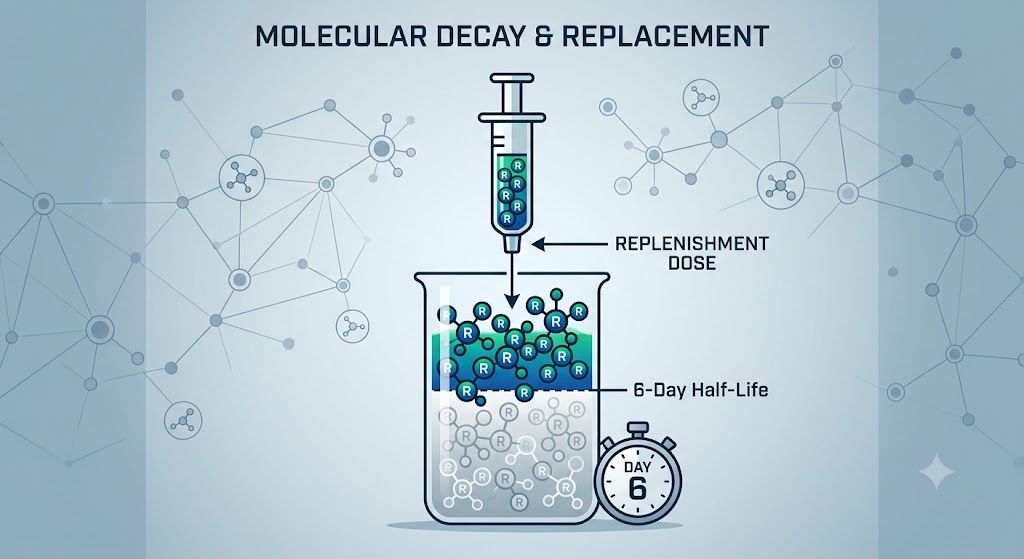
Pharmacologically, Telmisartan has the longest half-life of any ARB (~24 hours) and provides consistent 24-hour coverage with once-daily dosing — reducing the BP variability that can itself contribute to cardiovascular risk.
Its direct anti-hypertrophic and anti-fibrotic effects — independent of blood pressure — make it mechanistically well-matched to androgen-associated pathological remodeling.
The Catecholamine Pathway: The Secondary Driver
The second major pathway driving androgen-associated LVH runs through the sympathetic nervous system via catecholamines.
Catecholamines — dopamine, epinephrine (adrenaline), and norepinephrine (noradrenaline) — are tyrosine-derived monoamines that serve as both neurotransmitters and hormones. In the context of cardiac remodeling, their effects via beta-adrenergic receptors include:
- Direct stimulation of cardiomyocyte hypertrophy through β1 receptor signaling
- Increased heart rate and contractility, raising myocardial oxygen demand and mechanical stress on the LV wall
- Stimulation of renin release from the kidneys — feeding back into the RAAS and amplifying angiotensin II production
- Promotion of myocardial fibrosis through chronic adrenergic stimulation
Androgens increase sympathetic nervous system tone and catecholamine sensitivity, making this pathway an independent contributor to LVH separate from RAAS effects.
Beta Blockers and LVH Regression
Beta-adrenergic blockade directly counters this pathway. Studies on propranolol and other beta blockers have demonstrated measurable regression of LVH indices — reduction in LV mass, wall thickness, and related structural markers.
The average effect size is smaller than what's observed with ARBs or ACE inhibitors, which makes sense mechanistically: catecholamine-driven LVH is real but secondary to RAAS-driven LVH in most contexts. However, the two pathways are additive — blocking one while leaving the other unaddressed leaves meaningful hypertrophic stimulus in place.
The Complementary Framework: Why Both?
The case for combining Telmisartan and Propranolol rests on their non-overlapping mechanisms:
Percentages are illustrative of relative mechanistic coverage, not clinical trial data.
Telmisartan handles:
- AT1-receptor mediated vasoconstriction and elevated afterload
- Direct cardiomyocyte hypertrophic signaling via angiotensin II
- Fibroblast activation and myocardial fibrosis
- Aldosterone-driven fluid retention and preload
Propranolol handles:
- β1-mediated cardiomyocyte hypertrophy and remodeling
- Renin release (which would otherwise feed back into RAAS — closing a loop Telmisartan alone doesn't fully break upstream)
- Heart rate and contractility (reducing mechanical wall stress)
- Adrenergic fibrosis signaling
The renin-release effect of propranolol is particularly worth noting: by reducing renin, propranolol reduces the upstream production of angiotensin I, providing a partial upstream complement to Telmisartan's downstream AT1 blockade. The two drugs thus address the RAAS at different points in the cascade.
What the Anecdotal Evidence Suggests
Individual reports circulating in the androgen research community — including one from an individual known as Androgenic — describe echocardiographic confirmation of no abnormal LV growth after extended androgen use when this preventative combination was maintained throughout. An echocardiogram showing normal LV wall thickness and mass index after a period that would typically be expected to produce measurable changes is meaningful signal, even from a single case.
This doesn't constitute clinical trial data. But it is consistent with the mechanistic prediction: if you block both primary hypertrophic signaling pathways before remodeling takes hold, the heart lacks the sustained stimulus to grow pathologically.
Cardiac Monitoring Considerations
Pharmacological prevention should be paired with monitoring to verify it's working:
Echocardiography is the gold standard for assessing LVH. Key measurements:
- LV posterior wall thickness (diastole)
- Interventricular septum thickness (diastole)
- LV mass index (indexed to body surface area)
- Relative wall thickness (distinguishes concentric from eccentric patterns)
- E/A ratio and E/e' ratio (diastolic function — often impaired before systolic function)
Blood pressure monitoring is essential — both to titrate drug dosing and because sustained hypertension is itself a major LVH driver that any pharmacological protocol needs to actually control.
Resting heart rate below 60 bpm on propranolol suggests adequate beta blockade. Target range varies by individual.
What This Is Not
This post describes mechanistic rationale and research context — not a treatment protocol. Telmisartan and propranolol are prescription medications with their own risk profiles, contraindications, and dosing considerations that depend on individual factors a clinician must evaluate. Propranolol in particular carries risks in people with asthma, certain arrhythmias, and metabolic conditions that can interact with androgen use.
The goal here is to move the conversation past "androgens are hard on your heart" toward a more precise understanding of how — because precision is what makes intervention possible.
Quick Reference
| Question | Answer |
|---|---|
| Primary LVH pathway with androgens | RAAS activation → elevated Angiotensin II → AT1-mediated hypertrophy and fibrosis |
| Secondary LVH pathway | Catecholamine / adrenergic stimulation of cardiomyocytes |
| Most effective drug class for LV mass reduction | ARBs and ACE inhibitors (80-trial meta-analysis) |
| Telmisartan's key advantage | AT1 selectivity + PPAR-γ activity + 24h half-life; direct antifibrotic effect |
| Propranolol's role | Blocks adrenergic LVH + reduces renin release (upstream RAAS complement) |
| Monitoring gold standard | Echocardiography (LV mass index, wall thickness, diastolic function) |
This content is for educational and informational purposes only and does not constitute medical advice. Telmisartan and propranolol are prescription medications — their use, dosing, and suitability require evaluation by a qualified clinician. Nothing here should be interpreted as a recommendation to self-prescribe or self-administer any pharmaceutical agent. If you use androgens and are concerned about cardiac health, speak with a physician and request an echocardiogram.